MOWOOT Chronic Constipation Therapy Device
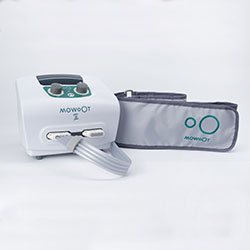
MOWOOT – the Natural Solution to Chronic Constipation MOWOOT is a new abdominal massage therapy system for chronic constipation. MOWOOT treats, manages and prevents chronic constipation without laxatives, enemas and colon cleansing supplements. MOWOOTis designed for home use and for use in clinics, hospitals and care homes. MOWOOT is compact, portable and easy to use. MOWOOT is light to carry and features a handle for easy lifting during moving from room to room and during travel or transportation. MOWOOT overview Safe, effective and clinically proven Helps to achieve regular and easier bowel movements Reduces discomfort and pain associated with constipation Eliminates intestinal gasses Reduces pain associated with abdominal bloating Reduces discomfort caused by evacuation Reduces time spent in the bathroom Improves health and wellbeing Improves appetite Improves quality of life Easy to use, comfortable and pleasant in use Convenient non-invasive and non-irritating treatment Cheaper than long-term ongoing purchases of laxatives Can be used sitting or lying down, thus utilising time Daily sessions of 10 to 20 minutes duration Improvements achieved as early as 3 to 7 days after first treatment Long-term use delivers lasting health benefits Treats 1 or 2 people simultaneously, as required Mains powered Medical device (CE 0086) 2 years warranty MOWOOT mimics manual abdominal massage normally performed by therapists, nurses or carers. Abdominal massage speeds up intestinal transit in people with chronic constipation and relieves constipation. MOWOOTis clinically proven to double evacuation frequency, soften stools, improve regularity, reduce gasses and bloating, relieve abdominal discomfort and effectively combat chronic constipation. MOWOOT can help people commonly suffering with chronic constipation, such as people with spinal cord injuries, multiple sclerosis and Parkinson’s Disease, people with constipation caused by taking certain medications, menopausal and post-menopausal women and the elderly people. Non-invasive and drug-free, MOWOOT abdominal massage therapy does not have side-effects associated with pharmacological anti-constipation interventions. MOWOOT therapy does not lose its effectiveness with long-term use. Comfortable and simple to use day after day, MOWOOT delivers effective solution to problems of chronic constipation. Regular daily use of MOWOOT alleviates constipation and improves quality of life! Just 10 – 20 minutes per day of MOWOOT abdominal massage produces improvements and significant results in only 3 – 7 days after the first treatment. Positive health benefits and greater quality of life are achieved with long-term daily use. MOWOOT abdominal massageis pleasant and relaxing. You can use MOWOOT sitting or lying down, when relaxing, reading, watching TV or working on your computer. MOWOOT is a desk top device with massage delivered via 4 independently attachable massage treatment belts. During treatment, a massage treatment belt is wrapped round the waist of the treated person. MOWOOT can treat 1 person or 2 people simultaneously as the MOWOOT desk top unit can connect with 1 or 2 treatment belts. This makes MOWOOT very convenient for use in family settings with more than one chronic constipation sufferer and in care homes, where many people may need constipation relief treatment. MOWOOT massage treatment belts are made in 4 sizes and you simply choose the belt in your size. One MOWOOT device can treat more than one person, provided a belt in appropriate size is available. MOWOOT is a Class 2 Medical Device (CE 0086). For more info on MOWOOT contact Win Health Medical Ltd by phone on 01835 864866 or via e-mail to info@win-health.com or visit www.win-health.com Win Health Medical Ltd Unit 1, Oxnam Road Industrial Estate Jedburgh, TD8 6LS T: 01835 864866 / F: 01835 268136 E: info@win-health.com/ W: www.win-health.com M: https://www.win-health.com/mowoot2-chronic-constipation-therapy-system
Study by the FSA exposes young people with food allergies fear eating out

A new study conducted by the Food Standards Agency ( FSA ) has exposed that a high percentage of young people aged between 16-24 with food allergies fear eating out at restaurants and in some cases, have specifically avoided going out to eat. The FSA study showed a staggering 64% of food allergy sufferers had avoided going out in the last 6 months. These results could be down to the lack of faith allergen sufferers have in restaurants and menu options, or it could be that they’re comfortable with a certain restaurant and do not wish to ‘create a scene’ at a new establishment. The food industry has worked to give greater transparency on nutritional and allergen information across the last 5 years, after the European Commission introduced the ‘Food Information To Consumers’ legislation in 2014. This legislation made it compulsory to detail nutritional and allergen information on food packaging and non-prepacked food, including in restaurants and cafes. Responses to the FSA survey detailed that a high percentage of allergen sufferers were aware that it was a legal right for businesses to openly show ingredient information on the top 14 allergens. Understandably, when it’s a literal matter of life and death, sufferers may be cautious when trying new restaurants and dishes. Customers want to feel confident when ordering food and have an enjoyable and relaxing time when out. ELAS Food Safety Director, Fiona Sinclair, illustrates the hard work that the majority of food businesses have undergone to help allergy sufferers: “On one hand it is the case that the food industry overall provides more allergen information and has better controls in place than ever before. With the introduction of the Food Information for Consumers Regulations in 2014, many businesses have now got robust procedures in place to comply with the law and keep customers with allergies safe. For example, accurate information on allergens for each menu item, signage encouraging customers to tell them about their allergies, allergen buttons on tills, allergen awareness training for staff and managers and tight communication if a customer has an allergy. On the other hand, from our experience too many businesses still don’t have safeguards in place, some virtually none, and in such cases consumers are right to exercise cautions. We find this to be more common with smaller businesses who may still be unaware of requirements. For consumers with serious allergies their life is virtually in the hands of a chef or waiter. There are a few suggestions we would suggest for consumers with allergies, to help them assess whether the place they wish to eat out can be trusted. For example, check their food hygiene rating although this is a quite basic measure and not the be all and end all. Asking for allergen information, if it is not provided up front is a must, and gauging how the staff respond. Don’t be afraid to ask them what precautions they will take with your meal. Your’re much more likely to get a clear and forthcoming answer from a premises with safe and clear allergen procedures, well trained staff and effective management in place. Here at ELAS, some of our restaurant group clients have excellent procedures in place and as a result gain a lot of repeat business, as allergy sufferers trust them. However they still want customers to tell them at each visit if they have an allergy so they can take extra care when prepping their meal. So in summary, we can understand caution in eating out, but would recommend asking a few simple questions to gauge whether your restaurant or takeaway of choice can be trusted.” In May we held and STS Food Safety Round Table which resulted in a whitepaper focusing on allergen control within the food industry. Our whitepaper details the steps that businesses can take to safeguard their customers and employees when dealing with allergens. Some of the points discussed include: – Making sure your training is up to scratch – Your supply base management – Avoiding customer complacency – Reporting allergen complaints – Technology solutions You can download our Allergen whitepaper here.
The MOT Rules for WAVs Have Changed

If you own a Wheelchair Accessible Vehicle which is approaching or more than 3 years old, there have been some important changes regarding the requirements of the MOT Test, which now state under Section 7.1 (Seat belts and supplementary restraint systems (SRS)) that the MOT Tester must inspect: What Has Changed? Under previous MOT regulations there was no requirement for either the Wheelchair Occupant Safety Belt or Wheelchair Restraint Belts to be inspected. These new changes mean that your vehicle’s MOT Test can provide greater peace of mind that your WAV’s wheelchair restraints are in good working order. Brotherwood® have been campaigning for years for more stringent safety checks for critical wheelchair and passenger restraint systems, which are crucial for the safe transportation of wheelchairs and their users, and so we welcome these new regulations which ensure that your vehicle can continue to safely serve your needs for years to come. Why Is It Important? The WTORS (Wheelchair Tie-Downs and Occupant Restraint System) in your vehicle not only provide safety for the wheelchair user, but also all other vehicle occupants when travelling. These systems also provide a secure, stable ride for the wheelchair user and so inspecting these systems for proper operation and ensuring that they are free from damage will mean that your WAV continues to provide a comfortable, enjoyable journey. Can Brotherwood Inspect My WAV? For complete peace of mind we offer an annual Safety Assurance Programme. A qualified service engineer will visit at a time and place that suits you, to perform a full 15-point conversion safety inspection, including restraints, ramp, safety belts and more to ensure safe operation of your conversion. Although this is not an MOT Test, it can make sure that your wheelchair access conversion is operating at it’s best. To arrange a Home Service Visit, please Brotherwood here.
Assynt Crofters’ Trust launches its new Scottish Wheelyboat

This year is the 25th anniversary of the Assynt Crofters’ Trust taking ownership of the beautiful North Assynt Estate in the Highlands of Scotland, comprising of 21,300 acres with over 200 lochs. As part of a week-long celebration, the Trust will launch their new Coulam 16 Wheelyboat on Loch Drumbeg. The lochs are only accessible to the fit and able-bodied and therefore Assynt Crofters’ Trust is launching their new Wheelyboat to be able to offer all the Trust’s visitors, regardless of age or ability, the opportunity to fish and watch wildlife in this stunning setting. The fully accessible Coulam 16 Wheelyboat will be launched on Saturday 30 June, as part of a day’s fishing competition for all anglers to be involved in, either on shore, or on the boat. The purpose-built fishing boat is ingeniously modified for wheelchair access and is an essential facility on larger waters. This project with Assynt Crofters’ Trust is an important development, as it will create opportunities for mobility impaired anglers in a remote and pristine environment fishing for wild brown trout. Anglers will not be the only beneficiaries, however, as the Wheelyboat will also play an important role as an accessible boat for wildlife tourism. This joint project with Assynt Crofters’ Trust and The Wheelyboat Trust would not have been possible without the fundraising efforts of both charities. The Wheelyboat Trust contributed almost half of the total funds and provided a total of £5,000 from grants raised from Anne Duchess of Westminster’s Charity, Christina Mary Hendrie Charitable Trust, Mr J Collins, Mrs J Howman, JTH Charitable Trust, Lord Leverhulme’s Charitable Trust, Souter Charitable Trust, Sylvia Aitken Charitable Trust and Mr K Williams. Assynt Crofters’ raised their contribution from Assynt Fly Fishing, Living the Dream, Pudding Boy Productions, Scottish Hydro Electric and Scottish Water. Assynt Crofters’ Trust manages many of the lochs for trout and salmon fishing and fishermen return year after year, as the fish are wild and in great condition. As well as the fishing, there is the unrivalled opportunity to spot wildlife such as red deer, pine martens, golden eagles and red and black-throated divers. Wheelchair users and those who cannot walk long distances will now be able to access the beautiful Loch Drumbeg, with its many tree clad islands and wild brown trout, providing some of the most appealing fishing and wildlife-watching opportunities around. Developed by The Wheelyboat Trust and Coulam Ltd boatbuilders, the Coulam 16 Wheelyboat easily accommodates two wheelchair users and a companion/boatman. The wide open deck is accessible throughout and disabled anglers can drive the boat. Boarding is via a ramp from the bank, or a pontoon, onto a hydraulic platform and removable handrails keep the angler secure while boarding and disembarking. Andy Beadsley, Director of The Wheelyboat Trust says, “There is so much more to fishing than just catching fish – being able to take part easily, safely and often independently are important factors that benefits Wheelyboat users’ mental and physical health and well-being. The Coulam 16 Wheelyboat looks and performs like all other fishing boats, providing the performance of a purpose-built angling boat, but also being able to be used by anyone, disabled or not, appealing to all as a genuinely dual-purpose craft. This is extremely important for us at The Wheelyboat Trust – giving disabled people the same and equal facilities of the able-bodied. It is fantastic to see a Wheelyboat at Assynt Crofters’ Loch Drumbeg as it is a stunning location that can now be able to be enjoyed by all.” Ray Mackay, Vice Chair of the Assynt Crofters’ Trust said, “The Assynt Crofters’ Trust is celebrating the 25th anniversary of taking ownership of the North Assynt Estate this year. We have managed to keep the entire estate together and enabled the ordinary people who live and work on the land some control over their own economic future. The lochs on the Estate are absolutely stunning and the addition of our new Wheelyboat gives everyone the ability to enjoy and utilise this amazing environment. It is also wonderful to see the freedom a Wheelyboat gives all its users, from the less mobile and disabled, to the young and elderly. This launch will be the first event in a series to celebrate 25 years of the Assynt Crofters’ Trust.” The Wheelyboat Trust relies on the support of individuals, companies and charitable organisations to fund its activities. Donations can be made in a variety of ways including online at www.wheelyboats.org/donate.html. About Assynt Crofters’ Trust In 1989 Edmund H Vestey renamed the coastal crofting strip – comprising thirteen townships and a total area of 21,300 acres (9,000 Ha) – as North Lochinver Estate and sold it for £1,080,000 to a Swedish land speculator. In none of these transactions were the interests of the people who lived and worked on the land considered to be relevant. In 1992 Scandinavian Property Services Ltd went into liquidation, with a Swedish bank as the main creditor. The estate which had been sold to Scandinavian Property Services in three lots was now to be broken up into seven lots, no concern being shown for the impact of this process on the crofting activity of the inhabitants. Within three months, a feasibility study and business plan had been put together with financial help from the Crofters’ Union and Caithness & Sutherland Enterprise and so the Assynt Crofters’ Trust came into being. On July 1 there appeared the first of many reports in the national press about the audacious attempt of a few motley crofters in the remote NW Highlands to win back the land of their forefathers. The campaign caught the public imagination, donations began to roll in and negotiations began in earnest with the Liquidators. After having had two offers to purchase the Estate rejected by the selling agents, a deal was agreed in December 1992 – almost exactly 6 months after the original public meeting. The Assynt Crofters’ Trust is the owner of the North Assynt Estate which consists of some 21,000 acres and includes
Have you got the Changing Places Toilet Finder app?

Tom Gordon, who has a background as a master locksmith, produces RADAR keys for accessible loos and has developed an app to find your nearest Changing Places. Here, he speaks to UCan2 editor Victoria Galligan about why the UK falls short when it comes to Changing Places… What are the different types of accessible toilets and what is the difference between them? (Changing Places, disabled access, Space2Change etc) Disabled Toilets are correctly called “Accessible toilets” but not all accessible toilets are the same. Changing Place toilets have been designed for use by people who have a carer and include a full-size changing bench, a hoist and a peninsular toilet. Changing Places “U” toilets and Space2Change toilets are similar but don’t have all the features of the full Changing Places standard. Changing Places are NOT normally available for independent disabled people who can use a standard accessible toilet. How many of the accessible toilets do we have in the UK? There are 20,000-30,000 accessible toilets and 1,400 Changing Places in the UK, but there are never enough – partially because many councils are saving money. A dozen more are being built every month. Wales is particularly short of facilities. Which accessible toilets are locked, and do radar keys open all locked loos? There is no standard which demands public accessible loos are locked with a RADAR lock but the vast majority do use them, if they are locked. It all depends on the toilet provider –some have a local key or a code or an intercom or a card. Some you have to pay for entry. Our phone apps tell you how to get in to each loo at www.loo.org Eire and Europe and Australia all have their own National Key Scheme key –links from www.loo.org How much are the keys and what makes your keys a quality product? We have discontinued the steel keys which we supplied to RADAR for 25 years (until the charity shut down). They all still work all the locks but our new solid brass keys are improved in three main ways: • The unique raised rim to the head gives much better grip. • The computerised keycutting and other manufacturing and design improvements give a more reliable key, but we still have a master locksmith check every single key on two RADAR door locks (not the simpler mechanism of the padlock) to ensure that when a disabled person is outside the only toilet nearby which is suitable for them, they can reliably get inside. • It looks pretty, which is not irrelevant – why should a disabled person be forced to have an ugly product? They only cost £2.50 plus postage and discounts are available for bulk orders too! from www.radarkey.org Tell us about your app… Our fully checked app Changing Places Toilet Finder – which also includes Spaces to Change – are up and running. You can get the links from www.loo.org. We will be doing apps for UK public toilets and accessible toilets too. The website has the same data as the phone apps but the larger screen and power etc means that we can add extra features compared to the app. They all show where 1,400 Changing Places are, who can use them, opening hours, how to get there, how to find the toilet once you are there, how to get in and if it doesn’t comply with the full CP specifications, how it falls short. It even tells you the time of the next train or bus to get there. Why do you offer free signage for accessible loos? It seems to be a universal problem that public toilets are not well signed, so which means it can be: • Difficult to identify them, even when you are nearby. • Not clear who is meant to use each type of toilet. • Not clear what key etc is needed. • Difficult to find out about other toilets. • A mystery who to report faults to. Our FREE A4 door signs for all UK accessible toilets (not just ones with a RADAR lock) cover everything that a user needs to know, in an individually laser cut, nationally standardized format of sign. As we do business with most of the toilet providers, it was easy for us to contact the right people to get the necessary information and then use our existing skills and technology to solve this problem. For anything you need to know about public accessible loos including Changing Places, go to www.loo.org
5 Most Common Misconceptions About Life with a Disability

It’s an unfortunate fact of life that many people living with a disability have to deal with misconceptions and stigma on a daily basis. From ignorance and prejudice, to barriers to work and education, the effects of these misconceptions can have profound and wide-ranging effects on the lives of disabled people. UKS Mobility recently talked to 18 bloggers about their experiences and the misconceptions that those living with a disability face. Here, we take a closer look at the most common misconceptions they mentioned. We hope this will help raise awareness and reduce the stigma and improve conversation around disability. 1. All people with disabilities use wheelchairs This is one of the biggest misconceptions surrounding disability. People are often only assumed to be disabled if they use a wheelchair, but this erases a large proportion of the disabled community. Just 8% of people with disabilities use a wheelchair. In fact, disability covers a very broad spectrum of conditions. Many disabilities are invisible, such as visual and auditory impairments, autism, fibromyalgia and mental health conditions such as anxiety and depression. Each of these disabilities can have a profound effect on the person affected, but often these people are left underserved by society or even treated as frauds. By reducing disability to a very narrow spectrum, we leave people facing more stigma. Kirsten Schultz, who blogs at Not Standing Still’s Disease explains the way this misconception makes life more difficult: “Having multiple invisible illnesses, I struggle with people not believing I’m sick. I get sneered at from older people, stared at by those closer to my age and occasionally get comments about using my handicapped placard.” Similarly, Katherine Bouton notes the extent to which people assume that having a disability = using a wheelchair: “Quite a few people I know have checked off “hearing loss” as a disability needing accommodation at an airport (meaning signs, etc) and have found that someone has instead sent a wheelchair to meet them at the gate.” 2. People with disabilities don’t want or can’t be in relationships The idea that disabled people are unable to have romantic and sexual relationships is one of the most damaging misconceptions, as it creates a barrier that makes it more challenging for people with disabilities to experience these things. A lot of people assume that those with disabilities are asexual or don’t have the same need for love and romance. This frequently crosses the line into prejudice and preconception – in 2008, 70% of UK adults surveyed said that they probably wouldn’t have sex with someone with a physical disability. This misconception often means people with disabilities are not given adequate levels of reproductive and sexual health education whilst at school. This can cause problems further down the line, leaving younger people and those with learning disabilities particularly vulnerable to abuse. It’s vital that people with disabilities are given access to the same education and services as able-bodied people. Similarly, it’s often assumed that people with disabilities can only date other disabled people. Nicola Golding describes her experiences with this: “People always seem surprised when they find out my boyfriend is my boyfriend because they always assume he’s my brother. If someone hasn’t met then the first question I’m often asked about him is ‘is he disabled too?’ which always feels like people assume I couldn’t have an able-bodied partner.” 3. People with disabilities don’t want to travel Many people believe that those living with disabilities can’t travel, or don’t want to travel. This is often based on a narrow set of assumptions – for instance, that those with disabilities don’t have the money to travel, or even that they’d “obviously” rather stay at home. In reality, this simply isn’t the case. Many people with disabilities love to travel; in just two years in the USA, 25 million adults with disabilities made trips for leisure and business, altogether taking 73 million trips and spending around $17.3 billion. Despite this, it’s often a lack of accessible facilities that poses the biggest challenge to disabled travellers. Businesses and hotels often don’t know what people with disabilities need and fail to provide adequate facilities. For example, nearly three quarters of airline passengers with disabilities have experienced physical obstacles or miscommunication with airlines, and 8 in 10 have reported barriers and difficulties in UK hotels and resorts. It’s clear that the most important step to resolving issues around travelling with a disability is more understanding and better accommodation of disabled peoples’ needs. As blogger Cory Lee puts it, “We lead extraordinary lives and want to travel, just like anyone else. We just need destinations to be a bit more accommodating to make that a reality. When destinations do focus on accessibility, we’ll be thrilled to visit and spend our money there.” 4. People with disabilities are dependent on others It’s often assumed that people with disabilities can’t be independent and require large amounts of assistance and care. This is rarely the case. People with disabilities may have to adapt the way they do things, but this doesn’t mean that they can’t live independent lives. This can lead to patronizing behavior and awkward situations – for example, people with disabilities often find that people don’t talk to them directly, instead directing conversation at their friends and companions. “People in public try to talk to whomever I’m with, but I often open my mouth and surprise the stranger,” explains Laura Robb. We need to remember that people with disabilities are individuals and should be treated as such. Moreover, they can lead fulfilling and independent lives. Glen from Well Eye Never articulates this misconception: “It then takes people by surprise when they learn how much I do actually get out and about, on my own or with others, visiting lots of different places and having fun at lots of social events.” 5. Life with a disability isn’t normal Really, many of the other misconceptions about disability stem from this one – that life with a
Mobility Solutions deliver Cabin Car – a world-first in scooter technology

The first brand-new Cabin Car mobility scooter has been delivered to a happy customer, who is set to enjoy features including reverse camera parking sensors. Mrs Jordan in Knightswood, Glasgow, is is delighted with her purchase from Mobility Solutions. It is the world’s first scooter with reverse camera parking sensors, remote central locking and a heater. In fact, the Cabin Car has many comforts of a car whilst still being a mobility scooter. Mrs Jordan said, “I’ve been telling everyone about it, all of my friends are desperate to see it and I can’t wait to show it off. “All of the features will help me so much, if I was going out before I would have to wrap up with lots of layers but now I can just turn the heating on!” Sarah from Mobility Solutions is pleased to have been involved in the process, from initial demonstration through to delivery. She said, “The Cabin Car is a real head turner and packed with features, it’s just like a little car. A truly great part of my job is seeing our customers so happy and excited, and I know how much of a difference it will make to her.” The Cabin Car is easy to use and just like a car Kieron Macfarlane, retail manager at Mobility Solutions, tells us why the Cabin Car is a great option for people with mobility issues… Why would you recommend the Cabin Car to those with mobility issues? The Cabin Car has been designed from the ground up to be the perfect mobility scooter – it’s range and ease of operation are perfect even for users who lack fine motor control. The stylish design stands out from the crowd and the range of options including custom colours, upgraded batteries and sports seat all combine to make it the ultimate in mobility vehicles. How do the features of the Cabin Car help improve lives? The Scooterpac Cabin Car is designed to solve many of the issues faced daily by people with mobility problems. Standard equipment includes reversing cameras and extra large wing mirrors to aids visibility without the need to turn the head or body. The internal heater keeps the car warm in even the snowiest weather, allowing users with arthritis and other temperature-aggravated conditions to travel pain-free all year round. How is the Cabin Car powered and how long can it be driven for? Driven by a powerful 1400w motor and dual 75Ah batteries (100Ah upgrades available), the Car has the speed and endurance to cover 22 miles and that jumps to 30 miles if you upgrade the batteries. What kind of discounts/funding can people with mobility issues get to save on the cost price (£8,998 inc VAT)? Because the Car is designed from the ground up as a mobility scooter it falls under the standard Class 3 regulations for mobility products – that means no driving licence, tax or insurance are required. Funding for the Cab Car can be secured from any source that would fund a “traditional” mobility scooter, whether that is government grants, charitable donations or mobility/Motability schemes. The Cabin Car is available to purchase on mobilitysolutions.co.uk, or to discuss the various payment plans and optional extras, email info@mobilitysolutions.co.uk.
Driving Miss Daisy service launches its 30 branch in the UK

A driving service for people with mobility issues has launched its 30th franchise in the UK, joining a global community of supporting people who need transport. Driving Miss Daisy launched in the UK in 2014. Synonymous with and inspired by the Academy Award-winning film – which featured Morgan Freeman as a driver for his elderly client – the Driving Miss Daisy idea originated in Canada with just a single vehicle, and now spans across the world. UK Founder, Paul Nuth says, “I’m delighted that Driving Miss Daisy has celebrated its 30th UK franchise. We’ve transported children, the elderly and even pets, as our spacious cars can accommodate pushchairs, wheelchairs and even folding mobility scooters. All of our drivers are qualified first aiders and we are presently engaging in dementia and Alzheimer’s awareness courses.” One of the key reasons behind why Driving Miss Daisy has been so well received by the elderly and those that care for them, is that their companion drivers give clients back their independence in a reliable, safe and secure environment. The ethos behind their service is ‘We’re family when family can’t be there’ which is invaluable in the UK’s current overstretched climate. Their fleet of specialist vehicles are adorned with the brand’s daisy symbol and the drivers are affectionately known as ‘Daisies’. With franchises across the UK, Driving Miss Daisy have gained numerous glowing testimonies to their trusted service. Paul goes on to say, “So many families have grown to trust the service with their loved ones, knowing we will go the extra mile.” Driving Miss Daisy supports anyone with mobility issues, from children to pets! Just like the 1989 film, which received critical acclaim for its portrayal of a working relationship built on trust, the Driving Miss Daisy brand enables people in their local communities to lead more fulfilling lives, through the provision of companionship, transport and social engagement. With the Alzheimer’s Organisation predicting that the number of people with dementia in the UK is forecast to increase to over 1million by 2025 (as a worst case scenario) and with 40% of people suffering not living as well as they could, Driving Miss Daisy continues to work towards bridging this chasm by changing clients’ lives through the bespoke tailored services they offer. The Daisy team receive enquiries for additional UK franchises on a daily basis, as there is a growing demand for this quality of service in the UK. Driving Miss Daisy provides new franchisees with an ideal client base to grow a thriving and profitable business, whilst embracing the brand’s vision and passion. For more information about using the community service, please visit http://drivingmissdaisy.co.uk/ and for franchise opportunities please go to www.beadaisy.co.uk.
Dating agency launched to combat loneliness among adults with learning disabilities

A charity is hoping to combat loneliness by starting a friendship and dating agency for adults with learning disabilities. The new Luv2meetU service, which is run by the national learning disabilities charity Hft, will celebrate its launch with music, food, party games and pool. There will also be information about the service available for potential members and their supporters, and anyone interested in volunteering. Karen England, project development manager, said that the team plans on running eight events a month in the communities across Newcastle, Northumberland and North Tyneside, including bowling, karaoke, pub quiz nights, and any other activities that members express an interest in. They also plan to run specialist events for people on the autistic spectrum. Dating agency also aims to form friendships and extend social networks As Luv2meetU’s eighth branch, the new service will extend existing operations in the North. It is hoped that a further 40 individuals with learning disabilities will benefit from the service. Karen says programmes like Luv2meetU are essential for the wellbeing of people with learning disabilities. “We’re delighted to be able to extend Luv2meetU into these new areas,” she says. “There is a real need for this kind of service – research shows that people with learning disabilities frequently experience chronic loneliness, and many of the individuals we work with find it hard to meet people.” “We all have a right to make friends, go dating and maybe find love, and people with learning disabilities are no exception. We’re looking forward to welcoming lots of new members from the Newcastle area, and offering them a new way to socialise, have fun and be themselves.” The new service will be focussed on supporting people with learning disabilities and their families to develop and sustain relationships, improve health and wellbeing, and extend their social networks. It has been funded by The Forbes Charitable Foundation. Last year Luv2meetU celebrated its 10th anniversary. It was originally set up as a pilot in the Leeds and Wakefield area, supporting 40 people to get out and about, socialise and build friendships. The team now supports around 200 people, and has enabled dozens more to make friends and forge relationships. The event will be held at Newcastle’s Yates bar on Monday 29 January. To find out more about Luv2meetU, visit www.luv2meetu.com or contact luv2meetU@hft.org.uk.