Learning disability charity recognises outstanding volunteers
This Volunteers’ Week, national learning disability charity Hft is celebrating its 110 volunteers, who have dedicated more than 8,000 hours of their time in the last year. The charity offers various opportunities for volunteering, ranging from corporate volunteering and fundraising to a buddy scheme. Volunteers have the chance to make a difference to the lives of people with learning disabilities, while also gaining confidence, skills and new friendships as a result. Among Hft’s volunteers is Valerie Healy, 40, who started volunteering at a supported living service in Bristol at the start of 2018. The administrator was matched with a 40 year old at the service through the charity’s buddy scheme, which pairs people with volunteers with similar interests who can introduce them to new activities. The two now spend a day a week together, taking part in a range of activities including music, Zumba dancing and trips out. Valerie said: “I like volunteering for Hft as it is very uplifting. I’m always greeted with smiling faces and hugs. As a volunteer, you get such a great sense of achievement, friendship, and belonging. It’s really rewarding and an experience like no other.” Also giving up his time for the charity is Will Harris, who has cerebral palsy and works full time as a support worker for another provider. He has been with Hft’s friendship and dating service Luv2meetU since its inception in 2007 and has racked up nearly 1,000 volunteering hours. Will has taken on a range of roles including monthly days out where he supports up to six people to take part in local activities, as well as regular mentoring sessions with new volunteers. Other volunteers include 63 year old Kate Cross, who volunteers for Luv2meetU too. As a parent of a member of the unique dating service, Kate was inspired to start volunteering after witnessing first-hand the impact Luv2meetU had on her daughter. Contributing over 100 hours over the last four years, Kate has been heavily involved in fundraising events ranging from service launches to rotary dinners, and even two fashion shows, which raised over £4,000. She’s also used her expertise as a parent to help the Luv2meetU team develop stronger relationships with family members. Lorna Bird, Project Coordinator for Volunteering at Hft, said: “Volunteers are the lifeblood of many of our initiatives, which simply could not run without them. We’re delighted that our volunteers choose to give up their valuable time to Hft and are always looking for more people to join us in supporting people with learning disabilities to live the best life possible.” Volunteers’ Week takes place from 1 – 7 June this year and aims to celebrate and thank the millions of volunteers across the UK for the contributions they make. Hft currently supports more than 2,900 people with learning disabilities across the country. This includes supporting people with learning disabilities to live with as much independence, choice, dignity and control as possible. That can range from helping someone to find a job, make friends or adapting their home so they can enjoy a greater level of independence.
Ordinary People Doing Extraordinary Things
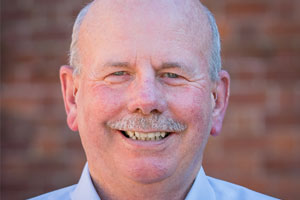
Volunteers are at the very heart of the success of Riding for the Disabled Association (RDA), and are the glue that binds every aspect of the charity together. Every year, Volunteers’ Week (June 1-7) provides a chance to celebrate the amazing contribution that is made by ordinary people from every walk of life who give up their valuable time to benefit others. But, as a recent RDA report found, volunteering doesn’t just benefit the participants but has a huge role to play in tackling loneliness and mental health, helping people gain more perspective and become less inward focused. There are many different roles fulfilled by volunteers, without whom the charity wouldn’t be able to carry out its life-changing work. From people on the ground assisting riders at RDA Groups up and down the country to the dedicated fund-raisers, whose constant determination ensures the books balance, volunteers are vital. To celebrate the 50th anniversary of RDA in 2019, their 50 Faces campaign is telling the story of 50 volunteers, members and participants, to highlight their fantastic achievements. Here we meet one of the 50 Faces, volunteer, Doug Smith, who is testament to the fact that volunteering with RDA could lead to exciting adventures all over the world. At the age of 45, Doug Smith found himself unemployable, uninsurable and not realising he was sinking into clinical depression. Born and bred in Handsworth, Birmingham, Doug’s first picture of him riding was on a donkey called Silver at Weston Super Mare around 1959 and in 1973 he joined the Mounted Police, a career he thoroughly enjoyed until one fateful day. “At first I rode and trained on a variety of horses but after a while I was allocated my own horse to train and I ended up taking him to Orgreave during the Miner’s Strike.” Said Doug, a member of the Stafford and District RDA Group. “He was only a little horse, but he had the heart of a lion, galloping on the road into a full-blown riot. “You’d go from something like that to the Pope’s visit to Coventry. Thousands and thousands of people, and suddenly we were surrounded by about 200 singing nuns. That was crowd control of the best kind!” Doug’s spiral out of control started when he broke his back, being thrown from a horse, leaving him in a full body cast and spending four months in a metal cage. Until then he had produced a number of horses from raw youngsters enjoying the process and the time it takes to build their trust. When Doug found himself out of work and at a low ebb following his accident, it was suggested to him that he might like to go to the Atlanta Paralympics as a volunteer. On his return he threw himself into volunteering at RDA and with his wealth of riding experience he became a much valued member of the team and by his own admission it transformed his life. In 2000, Doug travelled to Australia where he was yard manager for the Paralympic team at the Syndey Olympics, with his philosophy being that it’s the contribution of volunteers that preserve an event. Adds Doug: “I have met some incredible people from all around the world and worked with a huge variety of horses. “The Atlanta Olympics were one on their own. Without doubt the RDA has provided so many amazing experiences and taken me all around the world, meeting lots of lovely people. “As an RDA volunteer we should be bloody proud of what we do, and not go around saying, I’m just an RDA volunteer. I’m sorry that just winds me up; you’re not just an RDA volunteer. You are an RDA volunteer. Be proud. “It is important to be professional in everything we do and that way we will be respected in the equestrian world. “There are fabulous people in the RDA who do amazing jobs and we have to aspire to that.” Volunteering with RDA – Horses, Health and Happiness RDA recently surveyed over 1,500 of its volunteers to understand the impact of volunteering on their physical and mental well-being. The results, presented to Parliament to launch RDA’s 50th anniversary, revealed the multiple benefits: 81% said that volunteering with RDA made them feel better about themselves. 88% said they felt like they belonged to the RDA Community. 93% said volunteering helped to keep them physically active 95% of RDA volunteers feel they have gained knowledge and skills. 80% feel the knowledge they have gained has helped them in other areas of their life For more information about volunteering with RDA, to visit the 50 Faces project or download the report ‘Horse, Health & Happiness’ visit www.rda.org.uk
Meet the 50 Faces Breaking Down Barriers
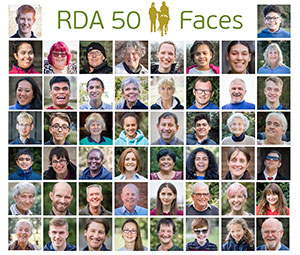
Riding for the Disabled Association (RDA) is celebrating 50 years of achievement, therapy and fun through horses with a stunning online collection of portraits and stories from all over the UK. Designed to challenge preconceptions about disability, volunteering and the world of horses, 50 faces is a celebration of the brilliant, fearless and pioneering people who make up the RDA family. Right from the start, RDA has helped to open up the world of horses to everyone. The charity’s radical mission in 1969 that ‘no disabled person who could benefit from riding shall be denied the opportunity of doing so’ was the start of a quiet revolution that is still breaking down barriers today. 50 Faces acknowledges and celebrates RDA’s impact on people’s lives, regardless of age or background, from those who horse ride and carriage drive for life changing therapy, to the Paralympians who started their journey with their local RDA group. “In our 50th year we want people outside of RDA to feel that they can get involved, and that means everyone. 50 Faces is about saying: if you think you know who takes part in horse sport – think again!” says RDA UK Communications Manager Caroline Ward. “RDA has spent 50 years breaking down the barriers to participation, championing the goals and achievements of disabled people and welcoming volunteers and supporters from all walks of life. By reading just a few of the stories behind the people, hopefully we can inspire more people to join in.” Among the 50 faces are Paralympian Sophie Christiansen CBE, Eventer Bill Levett’s son Josh, renowned jockey Tyrone Williams and Countryfile ‘Farming hero’ Julia Evans. The campaign also features a Bolivian basketball player, a Hollywood stunt double, a motor racing coach, a horse racing nun and the woman who overcame all the odds to start Riding for the Disabled in Russia. Explore the 50 faces project at www.rda.org.uk/50-faces Meet RDA volunteer, trustee and rider, Colin Duthie, Carrick RDA, Scotland “At the age of 20, I was run over by a lorry. I suffered horrendous injuries – including an above knee amputation. “My first experience of horse riding was through my local RDA. To say it was a profound experience would be an understatement. Horse riding really did save my life. You have to understand, at that time I was in a very bad way, both physically and mentally mainly due to not being able to walk. “However, going from losing one leg to gaining four when riding was very cool, plus being on horseback was the only time I was out of pain. RDA gave me the confidence to challenge myself and others and put me on the path I am on now – living life to the full whilst helping others along the way. “Since then, I’ve done a wheelchair ascent of Ben Nevis, helped achieve a new world record for a team of wheelchair users pulling a Boeing 757, set up the South Ayrshire Tigers Powerchair Football Club and been on several long distance motorbike rallies for charity. “I’ve been a motorsport fanatic my whole life, but I never thought I’d get my race license and actually start racing – especially as a 54 year old lower limb amputee. I’m the first disabled driver ever to race in Super Lap Scotland. It was a dream come true. I’m also the first disabled person in the UK to become a Level 2 Motorsport Coach. In 2016 I helped set up the charity Disability Motorsport Scotland and so far we’ve arranged track days for over 130 disabled people as drivers and passengers. “I’m also now Chairman of Carrick RDA, where my life started again, way back in 1996. The last 35 years have been one heck of a rollercoaster – but I’d rather have the ups and downs than going nowhere. THANK YOU RDA, from the bottom of my heart, and from all my family and friends too. Here’s to the next 50 years.” Ordinary People Doing Extraordinary Things May 2019 Volunteers are at the very heart of the success of Riding for the Disabled Association (RDA), and are the glue that binds every aspect of the charity together. Every year, Volunteers’ Week (June 1-7) provides a chance to celebrate the amazing contribution that is made by ordinary people from every walk of life who give up their valuable time to benefit others. But, as a recent RDA report found, volunteering doesn’t just benefit the participants but has a huge role to play in tackling loneliness and mental health, helping people gain more perspective and become less inward focused. There are many different roles fulfilled by volunteers, without whom the charity wouldn’t be able to carry out its life-changing work. From people on the ground assisting riders at RDA Groups up and down the country to the dedicated fund-raisers, whose constant determination ensures the books balance, volunteers are vital. To celebrate the 50th anniversary of RDA in 2019, their 50 Faces campaign is telling the story of 50 volunteers, members and participants, to highlight their fantastic achievements. Here we meet one of the 50 Faces, volunteer, Doug Smith, who is testament to the fact that volunteering with RDA could lead to exciting adventures all over the world. At the age of 45, Doug Smith found himself unemployable, uninsurable and not realising he was sinking into clinical depression. Born and bred in Handsworth, Birmingham, Doug’s first picture of him riding was on a donkey called Silver at Weston Super Mare around 1959 and in 1973 he joined the Mounted Police, a career he thoroughly enjoyed until one fateful day. “At first I rode and trained on a variety of horses but after a while I was allocated my own horse to train and I ended up taking him to Orgreave during the Miner’s Strike.” Said Doug, a member of the Stafford and District RDA Group. “He was only a little horse, but he had the heart of a lion, galloping on the road into a full-blown riot.
Stairlift donations to transform palliative care
Acorn Stairlifts has announced plans to raise £20,00 for Marie Curie to fund 1,000 hours of care from its specially trained nurses. Continuing the partnership between UK-based stairlift manufacturer and Marie Curie, £10 will be donated to the charity for every stairlift installed before 9thJune. Acorn Stairlifts already installs up to 60 free stairlifts each year to Marie Curie patients, helping support people living with terminal illness by giving them the freedom to be cared for at home. Caren Larkman-Ayre, national sales manager at Acorn Stairlifts, said: “We’re very proud to be supporting Marie Curie, a charity that does amazing work caring for people during exceptionally difficult times. “Since our partnership began in 2016, we have installed more than 150 stairlifts for people living with a terminal illness, enabling them to be cared for at home and helping them to make the most of the time they have with their loved ones. “Every stairlift sold will help not only help the person who will benefit from its installation, but also the thousands of people across the UK who Marie Curie care for.” It is hoped that the money raised throughout the scheme will raise enough money to provide invaluable care and support for hundreds of terminally-ill patients and their families throughout the nation. Charlotte Scurrah, Corporate Development Manager at Marie Curie, added: “Acorn Stairlifts’ very generous initiative will go a long way to helping Marie Curie provide care for more people living with a terminal illness and their families. “Acorn Stairlifts’ support throughout our partnership has been fantastic and we’re thrilled to see the positive impact it’s had on so many people by enabling people to be cared for in their own homes. It is so rewarding to see the relief stairlifts provide and we’re looking forward to changing more lives together.” Emily’s story Emily Binks, 72, who was diagnosed with secondary breast cancer had an Acorn Stairlift installed when getting up and down stairs started to become a near impossible task. Mrs Binks explains:“Before the stairlift was fitted, I had to face unendurable pain to climb the stairs on all fours and then take one step at a time to get down. “My worried husband would have the exhausting task of helping me up the stairs before he left the house – meaning we always had to plan and think ahead. It was so restricting and took away much of our freedom.” Acorn Stairlifts offered Emily a stairlift as soon as they heard of her story. Emily added: whose standard of living improved drastically by the installation, said: “My standard of living has improved immensely since the installation and I have no fear going up the stairs now. It’s completely changed our lives; any worries of falling have been lifted and I have no restrictions on when I can go upstairs.” To find out more about Acorn Stairlifts and its partnership with Marie Curie, visit www.acornstairlifts.co.uk/mariecurie or call 0800 016 9075
Tapping into the Therapeutic Benefits of Horse Riding
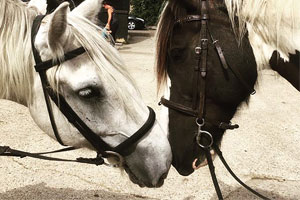
Tapping into the Therapeutic Benefits of Riding with Accessibility Mark Barnfields Riding Stables based in Chingford, London is looking forward to welcoming more disabled riders to take to the saddle, thanks to Accessibility Mark. Located near the popular horse riding locations of High Beach and Epping Forest, Barnfields Stables offer lessons to riders of all abilities but specialise in novice and nervous riders. Owner Natasha Burke decided to apply for accreditation after finding details of the joint scheme between the Riding for the Disabled Association (RDA) and the British Equestrian Federation online. Accessibility Mark aims to provide riding schools with the knowledge to confidently deliver sessions to disabled riders. The team at Barnfields was inspired to seek out more training to expand their services to disabled riders having seen for themselves the benefits that horse riding and spending time with horses can have, especially on riders with learning disabilities. Said Natasha: “We have seen first-hand the effect that horses can have on the well-being of people and we are teaching people for whom riding is beneficial both mentally and physically. All staff members have undergone the compulsory training with an Accessibility Support Officer (ASO), thoroughly enjoying the experience with enthusiasm to take on-board new techniques that they have being putting into practice. “We feel we are at a point where we have more to offer, we have perfect horses for disabled riders, and the staff are trained and ready to go! It will be rewarding for our staff and our yard.” added Natasha. Accessibility Mark status is awarded to a riding centre that has been approved by the RDA following training and assessment. The close link with the RDA means that it can offer continuous support to the establishment to ensure it provides a first-class experience that aims to be hugely beneficial to riders of varying levels of disability. There are currently 52 Accessibility Mark-approved centres across the country. To find your nearest RDA Group or Accessibility Mark centre visit www.rda.org.uk
Princess Anne Launches 50th Anniversary Tartan for Riding for the Disabled Association

HRH Princess Anne Launches 50th Anniversary Tartan for Riding for the Disabled Association in Scotland A new tartan has been produced by Lachcarron of Scotland in celebration of 50 years of Riding for the Disabled Association (RDA) providing therapy through horses. The tartan was launched at an anniversary event in Edinburgh by RDA President, Her Royal Highness, The Princess Royal. The Princess met with volunteers and participants from around the country and was presented with her very own RDA tartan scarf by brothers Andrew and William McLeod. In addition to launching the tartan, the event was an opportunity to celebrate 50 years of RDA in Scotland. There are 54 individual RDA groups in the country, supporting almost 3000 adults and children with physical and learning disabilities to benefit from horses. In her address to guests, Princess Anne thanked the volunteers – over 2,500 in Scotland – without whom RDA would not be possible. She acknowledged the whole team effort that it takes to help make such a real difference to people’s lives through riding and carriage driving. Kim McCutcheon, Edinburgh and Borders Regional Chair for RDA, said “The tartan has been designed to incorporate the charity’s colours and it was lovely to launch it at a special celebration alongside our wonderful volunteers and participants. It would be fantastic to see the tartan worn across the whole of the UK and by purchasing a scarf you are helping to support another 50 years of therapy through horses.” The event was kindly held at the People’s Postcode Lottery office in Charlotte Square, Edinburgh. Clara Govier, managing director of People’s Postcode Lottery said ‘It has been an honour to support Riding for the Disabled in celebrating their fiftieth year here in Scotland, and see the launch of their new tartan. “They are an incredible charity, working across Britain to improve the lives of thousands of people. They are hugely popular with the players of People’s Postcode Lottery and have received over £2.5 million in funding since 2013.’ Celebrations for RDA’s 50th anniversary are continuing throughout the year around the UK.
London transport nightmare
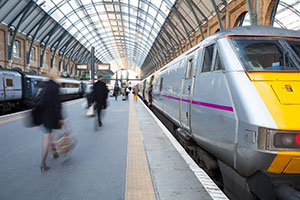
London transport nightmare – New travel experiment reveals dire commutes for wheelchair users. London wheelchair users’ commutes take 49% longer than an able-bodied person’s on average A shocking 71% of London tube stations NOT fully accessible Disabled public transport users don’t feel that official apps or planners cater to their individual needs The ‘Going the Extra Mile’ experiment enlisted the help of five wheelchair users who tested five popular commuter journeys in London. The study pitted wheelchair users and able-bodied commuters against each other, with each starting their journey from the same point, at the same time and finishing at the same destination. The experiment was carried out in an effort to raise awareness of accessibility issues on public transport. Longer commutes and restricted access to London’s transport network With only 77 out of 270 stations fully accessible for wheelchair users, London’s transport options are often very limited for people with disabilities, making their journeys longer and filled with challenges. The five commuter journeys carried out during the course of this experiment took wheelchair users a combined total of 3 hours and 5 minutes to complete – 49% longer than able-bodied participants. A simple 9-minute commute from Liverpool Street to Kings Cross took an astounding 32 minutes for the wheelchair user, whose only option was taking a single bus route – bus 205, between the two central London stations, due to the lack of accessibility of the underground. Wembley Park to Westminster, another popular commute route, took 83% longer than what the ‘step-free access’ option on the TFL journey planner estimated for wheelchair users. Jennifer, who tested the Wembley Park to Westminster route, avoids public transport altogether in her daily life: “Today was the first time I’d used public transport since [getting injured]. I probably won’t use it again”. Despite living close to 5 underground stations, Karl, another participant, revealed he is limited to using buses 90% of the time, a less than ideal scenario as “buses are unpredictable so it can get really difficult”. Travelling from Victoria to Oxford Circus – a journey that can take a mere 4 minutes for an able-bodied person – took Karl 73% longer because he had to use a bus route instead. Planning the journey: a challenge in itself Throughout the travel experiment, wheelchair users flagged the difficulty of planning their public transport journey as a recurrent problem. Cross-checking several different apps seems to be the norm although participants find most of these unreliable or inaccurate. They state that, ultimately, their own experience is most reliable: “I usually use Citymapper to plan my journeys,” reveals Karl, “but I tend not to rely on it”. Other wheelchair users disclose the meticulous work involved in planning a journey: “I use Google Maps’ satellite function to determine the state of the pavement I’d need to take” and the unforeseen obstacles that can frustrate them and delay their journeys: “If the bus stops at an awkward place, it can be a struggle wheeling up”. What is more, official apps and tools consistently fail to cater to wheelchair users’ individual needs. For the Westminster bound journey, the TFL journey planner suggested a change at Finchley Road to use the Jubilee line, in a similar manner to the able-bodied passenger. In reality, staff at the starting point of the journey advised this was not possible, as the gap there would be far too large for an electric wheelchair. It transpired that the route recommended by the journey planner would have only worked for a manual wheelchair user, potentially leaving any electronic wheelchair users stranded had they taken the recommended route. London commutes are paved with obstacles Despite carefully planning their journeys for the experiment, wheelchair users still encountered unforeseen obstacles and challenges, some of which they say are a regular occurrence on their commutes on public transport Transport staff are often unprepared to offer assistance. One participant was left waiting on a bus arriving at King’s Cross station, as the driver closed the doors before she could exit using the ramp. She disclosed some bus drivers have difficulty activating the ramp: “It sounds ridiculous, but sometimes the driver might even ask me for guidance on how to activate it! Or lacking altogether… On the Westminster bound journey, Jennifer, the wheelchair user doing the experiment, faced an unexpected challenge, as there was no staff present to assist with setting up a ramp at the destination, despite assurance from the information point that this had been arranged for her. This left Jennifer with only one option: relying on help from a stranger to exit and navigate the station. Difficult transfers are another prevalent issue. To get to the London Bridge bus station from the London Bridge underground station, the wheelchair user needed to traverse an entirely uphill transfer. “I’m a very active wheelchair user, but even I was tempted to stop for a minute to catch my breath”, revealed Sau, who took part in the experiment. These are only a few of the dreadful obstacles wheelchair users face on a regular basis on their London public transport journeys. We must bring attention to these facts, as there’s so much more that can be done to make public transport more accessible, reliable and pleasant for wheelchair users. For more information on the survey, see: boltburdonkemp.co.uk
Glendurgan Garden to improve accessibility for visitors
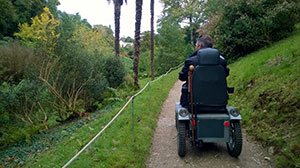
Glendurgan Garden, a National Trust property near Falmouth, recently introduced a brand new all-terrain mobility scooter, to help improve access for visitors. The all-terrain mobility scooter, known as a ‘Tramper’, allows visitors with mobility limitations to explore the Cornish gardens more fully, as well as visiting areas previously viewed as too difficult for them to access. Trampers are specifically designed to travel easily over uneven ground; allowing them to go up and down slopes, over bumps and tree roots, as well as through shallow puddles and mud. The Tramper at Glendugan was introduced a few weeks ago at the beginning of the season, and is available for visitors that struggle with walking – whether through age, or a permanent or temporary condition. You do not have to be registered disabled or have a Blue Badge to use it. Katie Reynolds, Visitor Experience Officer for the Glendurgan Garden, stated: “We’re thrilled to offer a Tramper here at Glendurgan. The steep valley paths in the garden can pose a challenge for some visitors; however, the Tramper navigates the garden with ease. “It’s been a real joy to see visitors return from their visit to the gardens with a beaming smile, saying how much it meant to them now they can visit the garden alongside their friends or family.” The Glendurgan Garden Tramper is one of 15 to be introduced by the Heritage Ability project, a three-year project funded by the National Heritage Lottery Fund. The project aims at helping to improve accessibility for disabled and Deaf people (using British Sign Language) to over 20 heritage sites in the South West. The 15 Heritage Ability Trampers purchased through the project will then operate as part of the Countryside Mobility Scheme, which offers to hire Trampers to visitors at nearly 50 beauty spots around South West England. Neil Warren, Manager of the Countryside Mobility, stated: “We’re delighted that the new Tramper has been so well received. I’ve been really impressed by the enthusiasm of the team at Glendurgan, who have helped to make their beautiful gardens easier to explore for those who would otherwise struggle. I’ve no doubt the Tramper will continue to prove popular with visitors and locals alike.” Visitors wishing to hire a Tramper for the first time can join the Countryside Mobility Scheme on arrival at Glendurgan, where staff will provide initial training. Membership, which then allows access to all the sites with Trampers, costs £10 for one year or £2.50 for a 2-week ‘Taster’ membership. For more information on membership or booking a Tramper visit the website. Members are strongly advised to phone and book the Tramper in advance of their visit to avoid disappointment. Both Heritage Ability and the Countryside Mobility Scheme are projects developed and run by Living Options Devon, a local user-led charity, where all of their initiatives are developed or supported by people who have a first-hand understanding of the challenges faced by disabled and Deaf people. Find out more
Inter Spinal Unit Games attracts 136 participants

32nd Inter Spinal Unit Games attracts 136 newly paralysed sports participants from across the country in April 2019 WheelPower, the national charity for wheelchair sport, recently welcomed 136 newly paralysed men and women representing 15 spinal injury units from across the United Kingdom and Ireland to the 32nd Inter Spinal Unit Games at Stoke Mandeville Stadium from 9-11 April 2019. Some had never played sports before, and each person had a different story to share as to how they became paralysed, yet all were willing to give the 26 different sports and physical activity sessions a try, before entering competition sports between the Spinal Unit teams. The flagship event finally culminated in a gala dinner and awards ceremony for all the participants, sports leaders and supporters of the event to celebrate the achievements and effort of all the participants and winners. The participants received expert coaching and demonstrations from leading wheelchair sports athletes and experienced coaches. ‘Have-a-Go’ sporting activities included: wheelchair basketball, athletics, wheelchair badminton, wheelchair fencing, handigolf, archery, boccia, wheelchair rugby, shooting, cue sports, powerlifting and for the first time adapted and wheelchair yoga. Chris Keogh, the amateur footballer who became paralysed after dislocating his neck playing the sport he loves, took part in the Games. “It’s been going very well, it has been great to try out all the different sports, it’s been absolutely fantastic. Since I had my injury I haven’t really been involved in too much and this has been a great week to try out everything that I didn’t even think was possible to do in a wheelchair, including wheelchair fencing, which I didn’t even know existed 12 months ago! It’s been absolutely great to be in an environment where people are in a very similar situation to me where they’ve just been under a year injured, it’s been fantastic and I have made lots of new friends, so I’ve really enjoyed it”, comments Chris. Chris was scheduled to begin a new job at Price Waterhouse Cooper just after his accident.