Paul Jacob’s world was turned upside down when he was involved in a motorcycle crash aged just 21, then he met support dog, Cassie.
He had been an apprentice plumber with a promising future.
But the collision left him with a spinal injury and he spent four months at Stoke Mandeville Hospital’s National Spinal Injury Centre before he was allowed home.
Now a wheelchair user, it took time and courage to rebuild his life.
“To go from being fairly active to being in a wheelchair, was quite the change,” says Paul now a 42-year-old dad-of-two.
But his love of dogs has helped him to face the world again and banish isolation.
Paul and his two-year-old black Labrador, Cassie, recently graduated as a successful Support Dogs partnership.
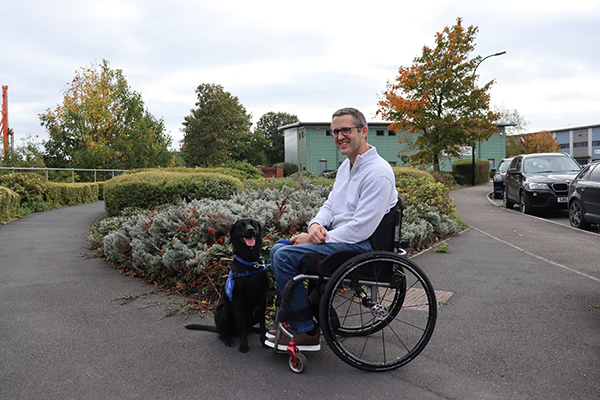
Yorkshire-based national charity Support Dogs trained Cassie to be a disability assistance dog – giving Paul lots more independence and freedom to enjoy family life.
“I struggle sitting in a chair trying to reach the ground and don’t have the use of my stomach muscles, so balance for me is quite difficult,” said Paul, from Wantage in Oxfordshire.
“Cassie has been trained to pick everything up off the floor.
“I’ve got two young kids, so there are often lots of clothes and toys – as soon as you turn your back, it’s all on the floor again.
“Cassie will pick up my shoes, her toys and she can even take clothes to the washing machine and help load the washing machine. She can also pull my socks and jacket off.”
The wonderdog has also been trained to close doors behind Paul, as well as push access buttons when out and about.
Paul retrained as a design engineer with his employer, Warburton Building Services, just eight months after his accident, a job he still holds.
He described how Cassie helps him both practically and mentally.
“When you go from able-bodied to disabled, going outside on your own can be quite scary at first, not knowing if you’re going to get into a situation such as falling out of your wheelchair,” said Paul, who is dad to seven-year-old Oliver and Benjamin, nine.
“It becomes quite anxious, but to have a dog with you relieves that anxiety of being on your own.
“Life would be a lot more difficult without Cassie, physically and probably emotionally.
“It’s also about getting out and seeing people, and seeing Cassie in her Support Dogs jacket facilitates people asking how she helps me.
“Having Cassie trained also means she can come into shops with me.”
Paul, who is married to Ida, a 41-year-old midwife, praised the work of Cassie the Support Dog, and support dogs in general, who also train and provides assistance dogs to help autistic children and adults with epilepsy to live safer, more independent lives.
“I think it’s amazing what the staff can teach a dog in such a short amount of time and how that affects people’s lives,” said Paul.
“It’s helped me so much – I can only imagine what it has done for others.”
Support Dogs provides all its services free of charge and relies on voluntary donations. To learn more or donate, please visit www.supportdogs.org.uk