Stephen Baker spent nine years protecting Queen and country, even guarding Buckingham Palace as a bearskin and red tunic-clad Coldstream Guard for three of them. But after sustaining multiple injuries while serving, he later became plagued with health issues, needing a support dog.
Stephen, 63, has also suffered two major strokes and a number of mini strokes and relied heavily on his wife Angela, who says he is lucky to be alive and couldn’t be left alone. But since having his pet dog, Bailey, trained by the national Support Dogs charity, for the first time in 40 years, Stephen is starting to regain his independence – and the pooch could potentially save his life.
Remarkable Labrador Retriever Bailey has been trained to give an alert bark if Stephen falls or needs help – a vital skill as a mini stroke could be a pre-cursor to a major stroke, which can prove serious or fatal.
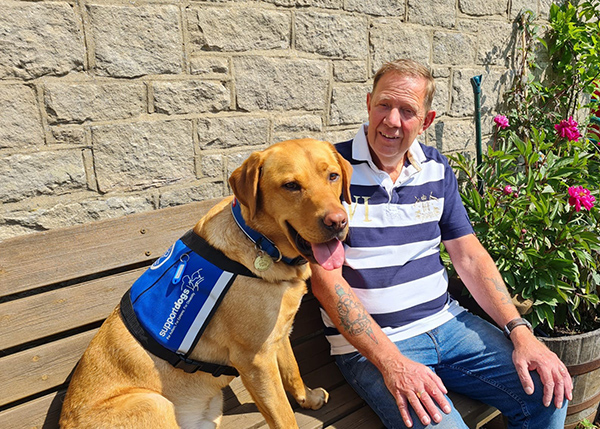
Dad-of-five Stephen, who lives in Northumberland, said: “Bailey is my best friend.
“It’s not just about giving myself confidence and reassurance both at home and while out and about, my whole family feel a lot more relaxed knowing Bailey is helping to keep me safe and looking after me.
“Now I don’t have to worry about being left on my own.”
Bailey can also pick up Stephen’s walking stick, open doors for him and helps out by picking up items like clothes and slippers.
This has not only benefitted Stephen hugely, but it has also given Angela more energy to help her husband, as she also cares for one of her daughters.
Stephen said he had been left in “embarrassing situations”, including a time when he had been in a pub and dropped his walking stick and couldn’t reach it and no one would help him.
But now he doesn’t have to worry about being left feeling so vulnerable, as Bailey will help – and seeing Bailey in his blue Support Dogs jacket makes people aware of Stephen’s disability.
Angela said: “Bailey is marvellous – he has changed Stephen’s life and mine too.”
Stephen signed up for the Army aged just 17 in 1979 and served around the world.
However, his military career was cut short when he was injured in action and was discharged from service.
Years later, Stephen deteriorated, having problems walking and suffering back and hip problems and he was hospitalised. He was later diagnosed with osteoarthritis, as well as sleep apnoea and breathing difficulties.
His condition worsens over the winter period and in the past two years he had suffered two severe strokes.
“He is lucky to be here,” said Angela.
“He got through the strokes but has mini strokes and he stands and can’t call for help and his face drops. He is high risk and if I’m in another room I can’t see that happening.
“But Bailey is trained to respond to a hand signal, if Stephen can move his hand, and spots this and will do a high-pitched bark.”
Although, thankfully, Stephen hasn’t experienced a mini stroke since Bailey’s arrival, the family ensure Bailey’s training is up to speed by Angela falling on the floor and practising what Bailey has been taught by Support Dogs.
“It’s fantastic,” added Angela. “It means I’m not on high alert having to think ‘does Stephen need me now?’ Whereas previously I was doing everything for Stephen – I was living his life and I was his body.
“I’m no longer his body – Bailey is my helper and it’s shared between me and Bailey. I can safely leave Bailey with him. It’s given Stephen his independence and also means more time for us.”
Stephen added: “Support Dogs is fantastic. I never hesitate to recommend the charity to others.”
To find out more about the incredible work of Support Dogs, which also trains and provides autism assistance and epilepsy seizure alert dogs, please visit www.supportdogs.org.uk or call 0114 2617800.